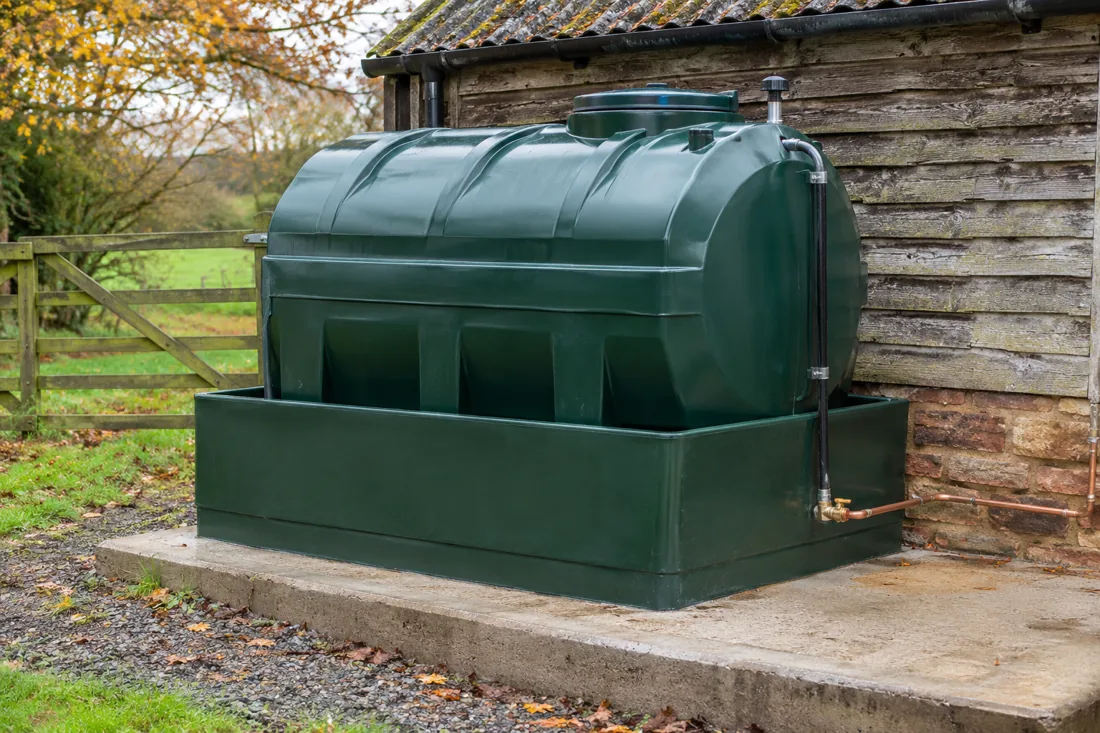
Is Replacement The Right Next Step?
Cracks, distortion, persistent corrosion or leaking seams call for assessment rather than another fuel delivery. A delivery refusal is also a reason to establish what needs correcting before ordering a new tank. Sometimes the concern is the base, pipework or location as well as the container itself.
Replacement gives you a chance to reconsider the whole installation. A larger tank is not automatically better for a rural home, and a similar-looking model may not fit the old base. Explain your heating demand, delivery pattern and any planned extension so the proposed arrangement still works after other building work.
Can The Existing Base Be Reused?
The base must suit the replacement manufacturer’s requirements and the loaded tank. An uneven slab, cracked paving or supports that have settled need attention before a new tank is filled. A photograph of the full base and its edges is more informative than a close-up of the tank alone.
The assessment should consider support, level, drainage and the surrounding ground. An integrally bunded tank may have a different footprint from the old single-skin model. If a new concrete base is proposed, ask about preparation and curing time because that can determine the programme and the need for temporary storage.
Which Tank And Position Make Sense?
Shape, capacity and material should follow the available space and the way the property uses oil. Slimline tanks can help with a narrow footprint, but inspection space, delivery access and safe separation still matter. Moving the tank may improve access while creating a longer pipe run that also needs assessing.
A bund is secondary containment around the oil-holding vessel. The installer assesses pollution risks, including routes to drains and water, before specifying it. GOV.UK says new and replacement domestic tanks in England must meet Building Regulations. Agree the compliance route and the proposed position before buying a tank independently.
What Happens To The Oil And Heating?
Recoverable oil can often be transferred, but it needs checking for water and sediment first. Tell us the current level and mention recent boiler lockouts or repeated filter blockages. These details help distinguish a straightforward transfer from a job that also needs cleaning or contaminated-liquid disposal.
There is an interruption while the oil supply is disconnected and reconnected. For a longer programme, ask whether an appropriately installed temporary supply is possible and what it adds to the price. Do not arrange an oil delivery during the changeover unless the installer and supplier have explicitly coordinated it.
How Is The Changeover Organised?
The planned sequence covers safe isolation, fuel recovery, removal of the old tank, base preparation and positioning of the replacement. New or retained pipework and fittings are checked as part of reconnection. Commissioning should establish that the installation and the connected heating system operate as intended before handover.
Access for people and equipment must stay available throughout. Let the contractor know if a gate can only be opened from inside, or if animals need keeping away from the route. Commercial sites should identify shutdown approval, security arrangements and any dependent equipment whose fuel supply cannot be interrupted without notice.
What Should The Quote And Handover Cover?
Ask for the tank make, model and capacity, base work, oil handling, old-tank removal and pipework scope in writing. Fire protection, lifting equipment and temporary storage should be visible items where required. Comparing the complete scope is more useful than comparing a tank-only price with an installed price.
Keep the manufacturer’s warranty information, commissioning details and the Building Regulations compliance documentation appropriate to the installation route. The contractor should also explain waste records for the removed tank and residues. Ask who will notify the work and how you will receive confirmation rather than assuming every certificate has the same purpose.
What Helps Us Assess A Somerset Property?
Send your postcode, photos of the tank and label, the complete base and the available position around it. Include the route through the garden, the narrowest opening and a view towards the nearest vehicle access. Mention slopes, soft ground, nearby drains and any known well or borehole.
Add the reason for replacement, rough fuel level and whether the home depends on oil for hot water as well as heating. Across low-lying parts of Somerset, describe any history of flooding at the property. The installation needs a property-specific assessment rather than assumptions based on the town or village name.
Your Questions Answered
Do I Need To Use Up My Oil First?
Oil tank replacement does not normally require you to use every litre first. The oil is assessed to decide what can be transferred and what must be removed as waste. Avoid deliberately running the system empty, and tell the contractor about the amount left so suitable holding capacity and equipment can be planned.
How Long Will Replacement Take?
Oil tank replacement time depends on the base, access, pipework and any change of position. A simple changeover can be shorter than a job requiring concrete preparation or temporary storage. Ask for the expected heating interruption and the full programme after assessment, including any period needed before the new base can be loaded.